

What are baroque pearls?
In the beautiful world of pearls, there are always some that are a bit too twisted. They twist and turn, with large heads and small tails, or are flat and irregularly shaped—these are Baroque pearls. They boast unique textures, shapes, and colors, resembling masterpieces of nature—each one is truly one-of-a-kind. Let’s take a closer look at Baroque pearls.
Table of Contents
What are Baroque Pearls? They are the antithesis of perfectly round pearls!
When people think of pearls, the image that often comes to mind is a perfectly round, smooth, and beautiful pearl. Even today, people still love round, lustrous pearls that embody purity and elegance.
But there is one type of pearl—the Baroque pearl—that breaks away from this classic image of perfection. It is neither round nor symmetrically oval, but instead takes on a wide variety of unique shapes, more diverse than you might imagine.
Their surfaces are uneven, with crisscrossing patterns that resemble nature’s free-flowing brushstrokes; each pearl possesses a unique “fingerprint.” This irregularity is not a flaw, but rather the most captivating feature of Baroque pearls! It represents a rebellion against tradition, a pursuit of individuality, and above all, a reverence for the power of nature.
The term “Baroque” originates from the Baroque art movement of early 17th-century Italy, a style renowned for its exaggerated, opulent, dynamic, and dramatic qualities. True to its name, the Baroque pearl embodies this unconventional aesthetic spirit, seamlessly blending the beauty of nature with the elegance of art.
How Are Baroque Pearls Formed? An Unexpected Surprise!
To understand how baroque pearls form, we must first understand the process by which ordinary pearls are created. When a grain of sand or other foreign object lodged inside an oyster cannot be expelled, the oyster secretes nacre to encase it, eventually forming a pearl that gradually rounds out during its development.
The creation of baroque pearls, however, is often accompanied by an “accident.” In the early stages of pearl formation, external factors—such as parasite infestation, algae attachment, sudden temperature changes, or malnutrition—can disrupt the oyster’s natural growth process. This causes the deposition of nacre to become uneven, ultimately resulting in baroque pearls with varied shapes and textures.
Imagine this: a tiny oyster struggling to survive in the turbulent ocean, absorbing different nutrients and enduring various pressures, its growth trajectory filled with uncertainty. It is precisely these “accidental” factors that give Baroque pearls their unique shapes and charm.
It is worth noting that Baroque pearls are primarily found in freshwater regions, such as China. Because freshwater environments are relatively complex, various factors that affect pearl growth are more likely to arise, making Baroque pearls relatively scarce and all the more precious.
In modern pearl farms, however, human intervention has emerged, allowing pearls to be shaped into the forms people desire.
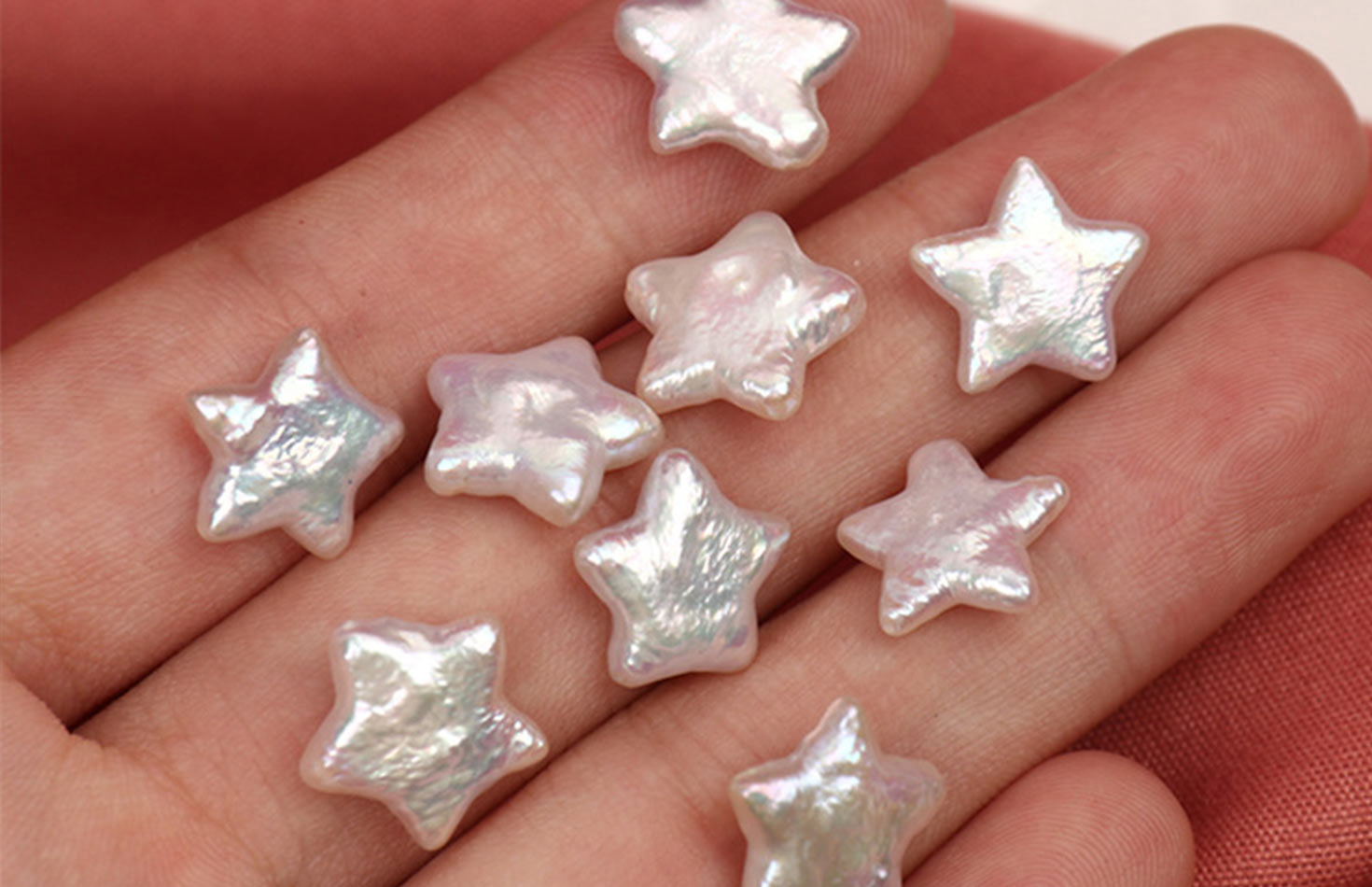
The beauty of baroque pearls is undeniable, and people love them for their uniqueness and individuality. Every baroque pearl is one-of-a-kind; no two are exactly alike. Their irregular shapes and textures give baroque pearls a unique character and charm, allowing them to better showcase the wearer’s taste and style.
People love making DIY jewelry with baroque pearls. Compared to buying ready-made jewelry that looks like everyone else’s, DIY jewelry offers greater uniqueness and cost-effectiveness, allowing you to mix and match baroque pearls of different sizes, shapes, and colors to suit your personal taste.
Making DIY jewelry with family and friends is a pleasure in itself; it helps people relax and experience the joy of creation.
You can use a large Baroque pearl as the centerpiece of a necklace, pairing it with a simple silver chain to create a distinctive vintage look; you can also string several small teardrop-shaped Baroque pearls together to make a bracelet, showcasing a fresh and natural style; or you can even combine them with accessories made from various materials to create your own one-of-a-kind work of art.